Now in 108 languages

A meditation app that respects your time, your nervous system, and the way you actually live.

ZenninOut is a calm, research-backed companion. Real breath work. Binaural beats generated on-device. A journey shaped by what you tell it. No buffering, no upsells, no woo.

Built around peer-reviewed research from Harvard, Stanford, MIT, NIH and the JAMA family.

Find stillness, daily.

Five minutes of the right practice will outperform fifty minutes of the wrong one. ZenninOut helps you find — and keep — the right one.

Built around four ideas.

Each one comes from a body of research we won't ask you to take on faith — every section links to the source.

Breathe

An orb that breathes with you.

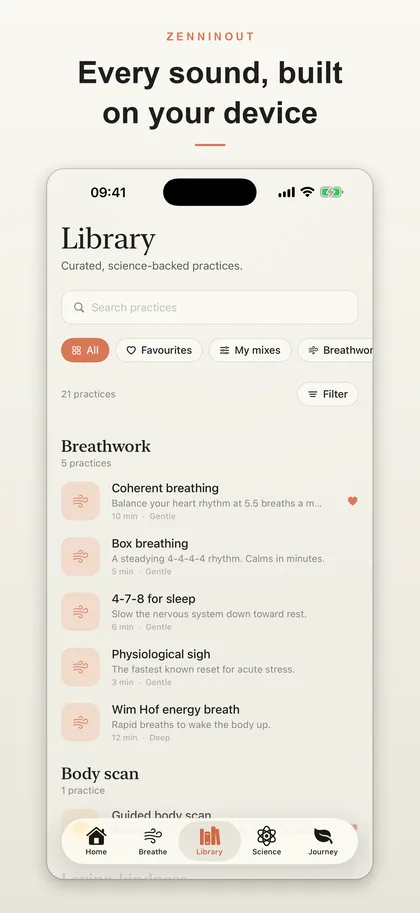
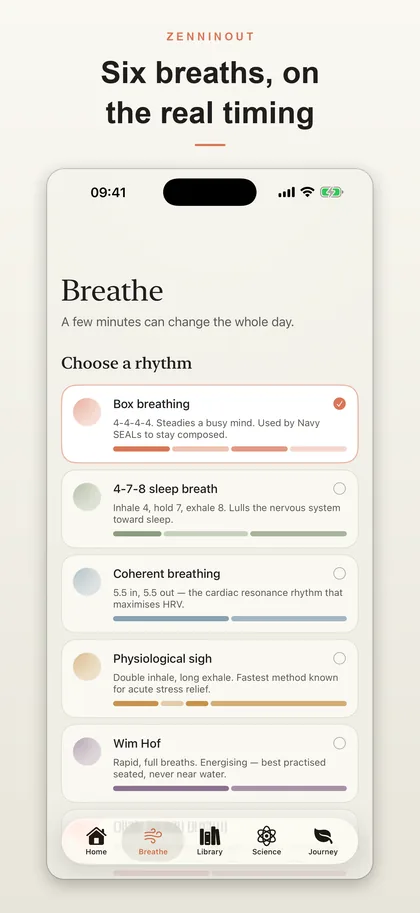
Six science-grounded breath patterns: box, 4-7-8, coherent (5.5 bpm), physiological sigh, Wim Hof, and Ujjayi. The orb expands and contracts on your inhale and exhale, with gentle haptics on every phase. Coherent breathing at 5.5 breaths per minute is the rhythm associated with the largest gains in heart-rate variability ever measured for a voluntary intervention.

Zaccaro et al., 2018; Lehrer & Gevirtz, 2014.
Sound

Audio generated on your device.

Binaural beats, brown noise, pink noise, ocean, rain, fire and singing bowls — all synthesised on-device with AVAudioEngine. No downloads, no buffering, no servers between you and stillness. Your alpha-frequency focus session at 10 Hz uses precisely two pure sine waves a tenth of a cycle apart; we let you see and adjust the carrier and beat directly.

Garcia-Argibay et al., 2019; Chaieb et al., 2015.
Science

Science you can actually read.

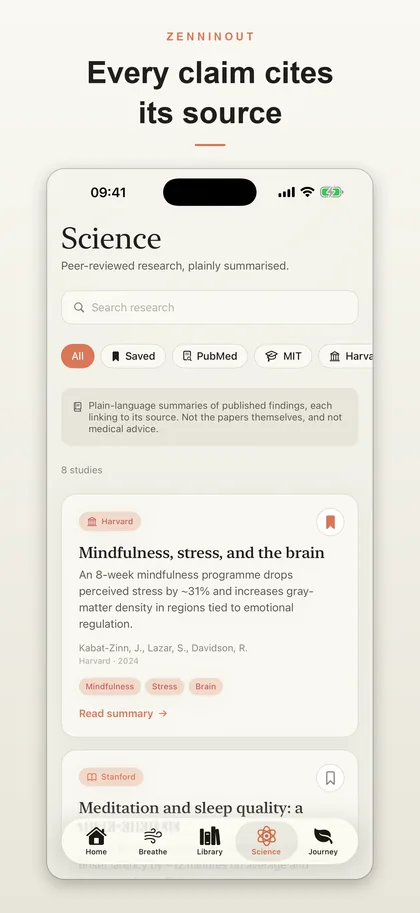
Every practice cites the research behind it. Sleep, attention, stress, neuroplasticity, sustained focus, social connection. Plain summaries you can read in two minutes, then full citations if you want to go deeper.

Goyal et al., 2014; Lazar et al., 2005; Brewer et al., 2011.
Journey

A journey, not a streak panic.

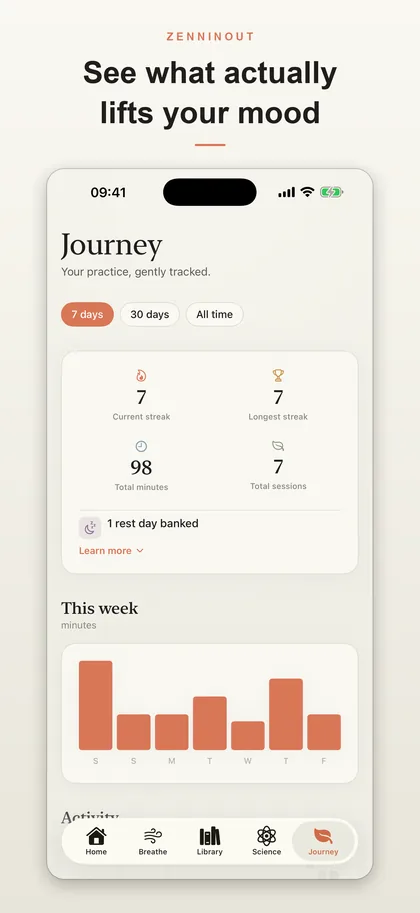
Mood check-ins before and after sessions, a gentle activity map, a journal that asks better questions than "how did it go?" The point isn't a long unbroken chain. It's noticing how you actually feel.

Fredrickson et al., 2008

Five tabs. One subscription, everything in it.

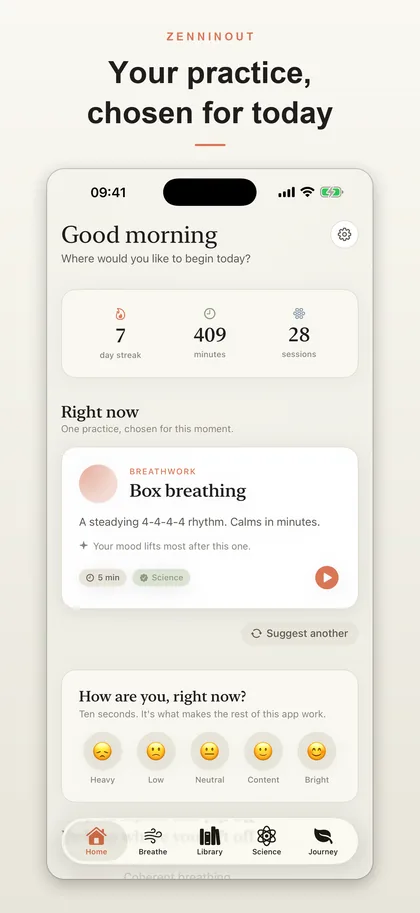
Shown here in your language — the app itself speaks 108. Every number on these screens is computed from your own practice, on your device.

ZenninOut app screenshot 1
ZenninOut app screenshot 2
ZenninOut app screenshot 3
ZenninOut app screenshot 4
ZenninOut app screenshot 5

See it in action.

Four short recordings, straight from the app. No mock-ups, no motion design — this is what shipping software looks like.

An orb that breathes with you

Coherent breathing at 5.5 breaths a minute. The orb expands and contracts on the real timing, so your body can follow it without counting.

Sound built on your device

An ocean soundscape synthesised live — and a mixer you can ride while it plays. Nothing is streamed, so it works identically in airplane mode.

A journey, not a streak panic

A month of practice: streaks with banked rest days, minutes per week, and the evidence view that shows which practices actually lift your mood.

Every claim cites its source

The Science tab: peer-reviewed studies, summarised in plain language, with the citation and DOI one tap away.

The research, in plain English.

Six findings that shape every decision we made.

  1. An eight-week mindfulness programme produces measurable gray-matter changes.

    Hölzel and colleagues used voxel-based morphometry to show increased gray-matter concentration in the left hippocampus, posterior cingulate, temporo-parietal junction and cerebellum after eight weeks of MBSR. The brain reshapes itself around the practice you actually do.

    Hölzel, B. K., Carmody, J., Vangel, M., Congleton, C., Yerramsetti, S. M., Gard, T., & Lazar, S. W. (2011). Mindfulness practice leads to increases in regional brain gray matter density. Psychiatry Research: Neuroimaging, 191(1), 36–43. doi: 10.1016/j.pscychresns.2010.08.006
  2. Long-term meditators have measurably thicker cortex in attention and interoception regions.

    Lazar's 2005 MRI study compared experienced meditators with matched controls and found increased cortical thickness in the prefrontal cortex and right anterior insula. The effect partially offset age-related thinning — 50-year-old meditators in the study had cortical thickness comparable to 25-year-old controls.

    Lazar, S. W., Kerr, C. E., Wasserman, R. H., Gray, J. R., Greve, D. N., Treadway, M. T., … & Fischl, B. (2005). Meditation experience is associated with increased cortical thickness. NeuroReport, 16(17), 1893–1897. doi: 10.1097/01.wnr.0000186598.66243.19
  3. Slow breathing reliably shifts the autonomic nervous system toward parasympathetic dominance.

    Zaccaro's 2018 systematic review of slow breathing (≤10 breaths per minute) across 15 studies found consistent increases in heart-rate variability, parasympathetic activity, and self-reported calm. The strongest effects clustered around the cardiac-resonance frequency of roughly 5.5–6 breaths per minute.

    Zaccaro, A., Piarulli, A., Laurino, M., Garbella, E., Menicucci, D., Neri, B., & Gemignani, A. (2018). How breath-control can change your life: a systematic review on psycho-physiological correlates of slow breathing. Frontiers in Human Neuroscience, 12, 353. doi: 10.3389/fnhum.2018.00353
  4. A single cyclic sigh, repeated for five minutes, outperformed three other breathing protocols for mood and arousal.

    Balban and colleagues (Huberman lab, 2023, Cell Reports Medicine) ran a randomised study of five minutes of daily breathwork across four conditions. Cyclic sighing — a double inhale through the nose followed by an extended exhale through the mouth — produced the largest gains in mood and the largest reductions in respiratory rate.

    Balban, M. Y., Neri, E., Kogon, M. M., Weed, L., Nouriani, B., Jo, B., Holl, G., Zeitzer, J. M., Spiegel, D., & Huberman, A. D. (2023). Brief structured respiration practices enhance mood and reduce physiological arousal. Cell Reports Medicine, 4(1), 100895. doi: 10.1016/j.xcrm.2022.100895
  5. Mindfulness meditation modestly but reliably improves anxiety, depression and pain.

    Goyal's 2014 meta-analysis pooled 47 randomised trials with 3,515 participants. Mindfulness programmes produced small-to-moderate improvements in anxiety (effect size 0.38) and depression (0.30) at 8 weeks — comparable to what antidepressants achieve in mild-to-moderate populations.

    Goyal, M., Singh, S., Sibinga, E. M. S., Gould, N. F., Rowland-Seymour, A., Sharma, R., … & Haythornthwaite, J. A. (2014). Meditation programs for psychological stress and well-being: a systematic review and meta-analysis. JAMA Internal Medicine, 174(3), 357–368. doi: 10.1001/jamainternmed.2013.13018
  6. Mindfulness meditation improves sleep quality in adults with sleep disturbance.

    Black's 2015 randomised trial in older adults with moderate sleep disturbance found that a six-week mindfulness programme improved sleep quality more than a matched sleep-education intervention, with secondary improvements in fatigue and depressive symptoms.

    Black, D. S., O'Reilly, G. A., Olmstead, R., Breen, E. C., & Irwin, M. R. (2015). Mindfulness meditation and improvement in sleep quality and daytime impairment among older adults with sleep disturbances: a randomized clinical trial. JAMA Internal Medicine, 175(4), 494–501. doi: 10.1001/jamainternmed.2014.8081
  7. Auditory beat stimulation can shift attention and anxiety in measurable ways.

    Garcia-Argibay's 2019 meta-analysis of 22 studies on binaural-beat stimulation found small-to-medium effects on anxiety, working memory and pain perception. Effects are subtle and dose-dependent rather than dramatic; we treat them as one tool of several rather than a magic frequency.

    Garcia-Argibay, M., Santed, M. A., & Reales, J. M. (2019). Efficacy of binaural auditory beats in cognition, anxiety, and pain perception: a meta-analysis. Psychological Research, 83(2), 357–372. doi: 10.1007/s00426-018-1066-8
  8. Loving-kindness meditation increases positive emotions and broadens social resources.

    Fredrickson's seven-week field experiment showed that loving-kindness meditation produced shifts in daily positive emotion, which in turn led to durable increases in personal resources — purpose, social support, fewer depressive symptoms.

    Fredrickson, B. L., Cohn, M. A., Coffey, K. A., Pek, J., & Finkel, S. M. (2008). Open hearts build lives: positive emotions, induced through loving-kindness meditation, build consequential personal resources. Journal of Personality and Social Psychology, 95(5), 1045–1062. doi: 10.1037/a0013262
  9. Experienced meditators show quieter default-mode network activity — the brain's mind-wandering hub.

    Brewer and colleagues found that across three meditation types, experienced practitioners showed reduced activity in the default mode network's main nodes, and stronger coupling with regions of cognitive control — both during meditation and at rest.

    Brewer, J. A., Worhunsky, P. D., Gray, J. R., Tang, Y.-Y., Weber, J., & Kober, H. (2011). Meditation experience is associated with differences in default mode network activity and connectivity. PNAS, 108(50), 20254–20259. doi: 10.1073/pnas.1112029108
  10. Breathing near six breaths a minute maximises heart-rate variability through cardiac resonance.

    Lehrer and Gevirtz review the mechanism behind resonance-frequency breathing: at roughly 5.5–6 breaths a minute, breathing, blood pressure and heart-rate rhythms synchronise, maximising HRV and exercising the baroreflex. This is the rate ZenninOut's coherent-breathing practice uses.

    Lehrer, P. M., & Gevirtz, R. (2014). Heart rate variability biofeedback: how and why does it work? Frontiers in Psychology, 5, 756. doi: 10.3389/fpsyg.2014.00756
  11. Auditory beat stimulation shows measurable effects on cognition and mood — with honest caveats.

    Chaieb and colleagues review the binaural-beat literature: effects on memory, attention and anxiety exist but vary with frequency, exposure time and study quality. ZenninOut cites this review rather than overselling the effect.

    Chaieb, L., Wilpert, E. C., Reber, T. P., & Fell, J. (2015). Auditory beat stimulation and its effects on cognition and mood states. Frontiers in Psychiatry, 6, 70. doi: 10.3389/fpsyt.2015.00070
  12. After acute stress, people recover faster listening to nature sound than to urban noise.

    Alvarsson and colleagues stressed participants with a mental-arithmetic task, then measured skin conductance during recovery. Sympathetic arousal fell faster during nature sound (a fountain and birdsong at 50 dB) than during any of three noise conditions.

    Alvarsson, J. J., Wiens, S., & Nilsson, M. E. (2010). Stress recovery during exposure to nature sound and environmental noise. International Journal of Environmental Research and Public Health, 7(3), 1036–1046. doi: 10.3390/ijerph7031036

Twelve of the studies that shaped the app. Inside ZenninOut, every practice links to research like this — the Science tab summarises each study in plain language and links to the source.

ZenninOut is a wellness tool, not medical or mental-health care. If you're in distress, please reach out to a professional or local emergency services. Meditation can occasionally surface difficult feelings — pause and seek support if it does.
Available in 108 languages.

Pick your language at first launch or switch any time from Settings — the whole app, including the onboarding, the practices, and the science summaries, follows you.

Right-to-left scripts (Arabic, Hebrew, Persian, Urdu, Pashto and more) are fully mirrored. Languages without a complete translation fall back gracefully to English on a per-string basis.

EnglishEnglishEspañolSpanishFrançaisFrenchDeutschGermanItalianoItalianPortuguêsPortuguesePortuguês (Brasil)Portuguese (Brazil)NederlandsDutchSvenskaSwedishDanskDanishNorskNorwegianSuomiFinnishÍslenskaIcelandicGaeilgeIrishGàidhligScottish GaelicCymraegWelshCatalàCatalanGalegoGalicianEuskaraBasqueOccitanOccitanRomânăRomanianFryskWestern FrisianLëtzebuergeschLuxembourgishMaltiMaltesePolskiPolishČeštinaCzechSlovenčinaSlovakSlovenščinaSlovenianHrvatskiCroatianСрпскиSerbianBosanskiBosnianМакедонскиMacedonianБългарскиBulgarianРусскийRussianУкраїнськаUkrainianБеларускаяBelarusianLietuviųLithuanianLatviešuLatvianEestiEstonianShqipAlbanianΕλληνικάGreekՀայերենArmenianفارسیPersianKurdîKurdishپښتوPashtoहिन्दीHindiবাংলাBengaliमराठीMarathiગુજરાતીGujaratiਪੰਜਾਬੀPunjabiதமிழ்TamilతెలుగుTeluguಕನ್ನಡKannadaമലയാളംMalayalamසිංහලSinhalaनेपालीNepaliسنڌيSindhiاردوUrduالعربيةArabicעבריתHebrewአማርኛAmharicትግርኛTigrinya简体中文Chinese (Simplified)繁體中文Chinese (Traditional)မြန်မာBurmeseབོད་སྐད་Tibetan日本語Japanese한국어KoreanBahasa IndonesiaIndonesianBahasa MelayuMalayBasa JawaJavaneseBasa SundaSundaneseFilipinoFilipinoMalagasyMalagasyไทยThaiລາວLaoខ្មែរKhmerTiếng ViệtVietnameseTürkçeTurkishAzərbaycanAzerbaijaniOʻzbekUzbekҚазақKazakhКыргызKyrgyzТатарTatarTürkmenTurkmenМонголMongolianMagyarHungarianქართულიGeorgianKiswahiliSwahiliHausaHausaYorùbáYorubaIgboIgboisiZuluZuluisiXhosaXhosaSesothoSesothoChiShonaShonaKinyarwandaKinyarwandaChichewaChichewaSoomaaliSomaliOromooOromoEsperantoEsperantoLatinaLatinKreyòl AyisyenHaitian CreoleAvañeʼẽGuaraniRuna SimiQuechuaAymarAymaraDiné BizaadNavajoʻŌlelo HawaiʻiHawaiian

From people a few weeks ahead of you.

Before

“I'd start, then drop off in three days.”

After

“Eight-minute mornings are a non-negotiable now. My sleep is genuinely different.”

S., five weeks in

Before

“Breathing apps always felt corny to me.”

After

“The 4-7-8 before bed actually works. I wake up less.”

M., three weeks in

Before

“I bounced between three apps trying to find one that wasn't trying to sell me something every screen.”

After

“This one just lets me practise. The science page is the bit I didn't know I wanted.”

A., two months in

Common questions.

The answers people search for most.

Is ZenninOut free?
Yes. The app is free to download with no subscription. There are no in-app purchases, no ads, and no upsells in the practice screens. Optional support is welcome but never required.
Does ZenninOut work offline?
Yes. All audio — binaural beats, brown and pink noise, ocean, rain, fire, singing bowls — is synthesised on your iPhone with AVAudioEngine. The app does not stream and does not require an internet connection to practise.
Is meditation actually backed by science?
Yes, with caveats. Effects are real but modest. Goyal et al. (JAMA Internal Medicine, 2014) pooled 47 randomised trials and found small-to-moderate improvements in anxiety, depression and pain. Long-term practice is associated with measurable changes in brain structure (Lazar et al., NeuroReport, 2005; Hölzel et al., Psychiatry Research: Neuroimaging, 2011). Every claim on this site links to its peer-reviewed source.
How long should a session be to actually help?
Five to ten minutes a day, done consistently, beats one long weekly session in almost every study. ZenninOut's defaults are 3, 5 and 10 minutes for that reason.
Do binaural beats really work?
Modestly. Garcia-Argibay et al. (Psychological Research, 2019) meta-analysed 22 studies and found small-to-medium effects on anxiety, working memory and pain perception. We treat binaural beats as one tool of several, not a magic frequency.
What's the best breathing pattern for anxiety?
Two evidence-based options: the cyclic sigh — a double inhale through the nose followed by a long exhale through the mouth — produced the largest acute mood gains in Balban, Huberman et al. (Cell Reports Medicine, 2023). For sustained calm, coherent breathing at 5.5 breaths per minute maximises heart rate variability (Lehrer & Gevirtz, Frontiers in Psychology, 2014).
Which languages does ZenninOut support?
108 languages, from English, Spanish and Mandarin through to Welsh, Hawaiian, Esperanto and Navajo. Right-to-left scripts (Arabic, Hebrew, Persian, Pashto, Urdu, Sindhi) are fully mirrored. You can switch the language at any time from Settings.
Does ZenninOut collect my data?
No. There are no analytics SDKs, no accounts, no servers receiving your sessions, mood entries or journal text. Everything stays on your iPhone.
Is ZenninOut a substitute for therapy or medication?
No. ZenninOut is a wellness tool, not medical or mental-health care. If you're in distress, please reach out to a professional or local emergency services (988 in the US, 116 123 in the UK).
What's the difference between this and Calm or Headspace?
Three things: every audio session is generated on-device rather than downloaded; every claim links to its peer-reviewed source so you can check the science; and the entire interface — onboarding, practices, science summaries — is available in 108 languages with no paywall.

Find stillness, in your language, today.

ZenninOut is free to download. No accounts. No ads. No data collection beyond what your iPhone holds locally.

Android and web coming after the next round of community translations.